
Hangman Fracture
Traumatic spondylolisthesis of the axis, also known as hangman's fracture, is one of the most common cervical spine fractures encountered in the trauma setting. Hangman's fractures are common injuries, and surgical treatment leads to an increase in the rate of osteosynthesis/fusion without significantly increasing the rate of complication. Both an anterior and a posterior approach result in a high rate of fusion, and neither approach seems to be superior.
During the past 30 years various treatment protocols for hangman’s fractures have been attempted. In order to guide the management of hangman’s fractures, different classifications have been introduced. However, opinions on operative or nonoperative treatment have not yet been solidified. To evaluate both conservative and operative management of hangman’s fractures in the published literature and to provide appropriate guidelines for treatment of hangman’s fractures, a systematic review of the literature regarding the management of hangman’s fractures was performed. An English literature search from January 1966 to January 2004 was completed with reference to treatment of hangman’s fractures.
The classification for treatment guidance from the literature was also reviewed. Regarding a primary therapy for hangman’s fractures, there were 20 papers (62.5%) that advocated for a conservative treatment and 11 of the remaining 12 papers suggested that conservative treatment was suitable for some stable fractures.
The classification of Effendi et al. Modified by Levine and Edwards was used widely. Most hangman’s fractures could be managed successfully with traction and external immobilization, especially in Effendi Type I, Type II and Levine-Edwards Type II fractures. It is necessary for Levine-Edwards Type IIa and III fractures to be treated with rigid immobilization.
Only for some stable Type I and Levine-Edwards Type II injuries, nonrigid external fixation alone was sufficient. Rigid immobilization alone was necessary for most cases.
Surgical stabilization is recommended in unstable cases when there is the possibility of later instability, such as Levine-Edwards Type IIa and III fractures with significant dislocation. The classification system proposed by Effendi et al.
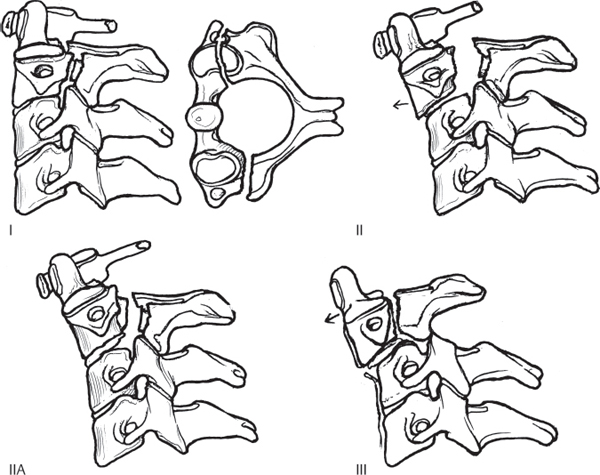
And modified by Levine and Edwards provided a clinically reasonable guideline for successful management of hangman’s fractures. IntroductionHangman’s fractures have been used to describe traumatic spondylolisthesis of C2 since it was initially noted in 1965 by Schneider et al. It is defined as fractures to the lamina, articular facets, pedicles, or pars of the axis vertebra. Hangman’s fractures are often caused by falling, diving or motor vehicle accidents. Today, the management strategies and the surgical indications for hangman’s fractures are still controversial, particularly for Type II and Type III according to Levine and Edwards.Systematic reviews and meta-analyses are now becoming an increasingly accepted means to achieve evidence based conclusions; and the methods can help surgeons to make rational decisions. The lack of adequate trials and publications comparing the efficacy of one way over another for the treatment of hangman’s fractures prompted us to perform an analysis of the literature on this subject.
In this evidence-based review, the current literature was examined to determine if there was any significant scientific evidence to support a standard modality for the management of hangman’s fractures. Since classification system is an important tool for guiding treatment of fractures and predicting prognosis, the classification of hangman’s fractures applied and the frequency of classification in the literature were also reviewed. Search criteriaRelevant literature search was performed using the most common database of medical literature as shown below:.Medline (Through Pubmed; 1966 to January 2002).Cochrane Central Register of Controlled Trials (2004–1).Current Contents (1996 to January 2004)The search strings and the number of hits were given in Table. The search was performed with limiting factors of “human” and “English language”. Some papers were found by manual methods. Additional articles identified from these references that contained relevant supporting information were then included. The search was performed by one reviewer.
Will it shoehorn in touch controls? Will it perform adequately? 
Inclusion/Exclusion criteriaAfter excluding identical papers, we carried out a selection of peer-reviewed articles to include. The selected articles should meet the following criteria:.The papers that focused on the treatment of hangman’s fractures were selected regardless of the number of patients.The articles without a clear description of fracture conditions and therapy were excluded.If the articles were reported by the same authors or from the same institute , , the most currently reported paper with detailed and complete clinical data would be included. If an equal number of patients were reported by the same authors –, the articles with the most information were selected.
The information extraction of articles was done independently to minimize selection bias and errors.All abstracts were printed and close-reading was performed by two surgeons with rich experience in spinal surgery. The different information extracted from the same article were compared and reread till the information could be agreed upon.
If it was difficult for them to obtain a consensus, a third reviewer was consulted. Finally, a total of 32 papers were selected to review. Full text of each paper was found, then, careful reading and data extraction was done independently by the two surgeons mentioned above. At last, all extracted information were imported into an electronic spread sheet—Microsoft Excel. Data extractionIn the articles we reviewed, the hangman’s fractures healed with suitable external immobilization were regarded as treated with the conservative method. The patients with combined cervical spine fractures were included in some papers; among them, if surgery was not performed because of hangman’s fractures, then the case was also regarded as managed with conservative method.
In cases treated conservatively, the different immobilization was noted and divided into rigid alone, nonrigid alone and both. The number of patients in three groups above was calculated.If the cases were treated with surgery, the number of patients underwent anterior, posterior and anterior–posterior approach was recorded, respectively.If a kind of classification system was adopted in an article, the above data was extracted according to the fracture type at the same time. The healing rate in every fracture type was calculated, too. Of patientsYear of publicationNo. Of deathClassificationPrimary therapyNo. Of conservative therapyAnterior approachNo.of surgery Anterior + posteriorPosterior approachSchneider et al.19650NoTractionMinerva jacket (3)18+ external immobilizationCervical brace (2)Collar (1)Halter traction (1)Cornish 19681NoSplint or traction in 3Splint (3)1014Surgery in 10Norrell et al. 19700StableUnstable fracture wereno mentioned therapy512Unstabletreated with operationTermansen 19741NoTraction orTraction +bed rest (10)219external fixationPlaster caster (5)Collar (1)Brashear et al.
19750NoTraction +Rigid immobilization (22)1C1-3 (3)29external fixationThomas collar (1)C0-C3 (1)or operated (if largeC2-C3 (1)displacement remained)Seljeskog et al. 19763A: single fracture ofTraction +Traction + cervical brace (15)126laminar-pedicle (8)immobilizatiomCervical brace (5)B: true hangman’sTraction + halo caster +fracture (18)Cervical brace (2)includingno subluxation (3)minimal. Management indicationTwenty of 30 (62.5%) publications advocated that the primary therapy for all hangman’s fractures should be conservative. Eleven publications suggested that conservative treatment was suitable to some stable fractures. Only Verheggen and Jansen claimed that surgery might be the primary method to Levine-Edwards Type II, IIa and III fractures.We reviewed and calculated the number of operative and nonoperative patients of each type according to Effendi et al.
And Levine and Edwards (Table ), the proportion of patients treated nonoperatively and operatively was shown in Fig. As shown in Table, most patients with Type I, Effendi Type II and Levine-Edwards Type II fractures were treated conservatively, whereas the proportion of nonoperative patients in Levine-Edwards Type IIa and Type III fractures were much smaller (Fig. ). Distribution of fracture type in nonoperative patientsThe healing rate of conservative management with regard to fracture type was presented in Fig.
The fracture healing was evaluated by radiological appearance in fracture site. The healing rate of patients with conservative treatment decreased sequentially from Type I to III fractures. All Type I fractures treated conservatively achieved successful healing, but the healing rates of both Levine-Edwards Type IIa and III fractures were below 50%. Conservative treatmentConservative treatment was usually effective for stable and neurologically normal patients when treated with appropriate immobilization at extended position. The results of this study indicated that surgical intervention is not necessary in most of Type I, Effendi Type II and Levine-Edwards Type II fractures.
According to postmortem examination, the fractures are usually located through the superior facet joint, which was full of well vascularized spongy cancellous bone. The narrowing of disc space with osteophytes was often observed in the film of hangman’s fractures for the combined damage to disk and ligaments, and this usually led to spontaneous fusion in severe cases.
Clinical practices have identified that it was usual to see the spontaneous union of hangman’s fractures which couldn’t have been influenced by the initial displacement or angulation. Healing in a malunion position with anterior displacement was common and it may be not harmful ,. According to the analysis of reviewed articles, 20 papers (62.5%) advocated that the primary therapy of all hangman’s fractures should be conservative, and 11 of the rest suggested that conservative treatment was suitable to some stable fractures. Conservative treatment was adopted over 70% in Type I, Effendi Type II and Levine-Edwards Type II fractures, and the healing rate of each type of fracture was 100% in Type I, close to 90% in Effendi Type II and 60% in Levine-Edwards Type II fractures among patients with conservative management. According to our analysis presented in Fig., where conservative treatment was used as the primary therapy of Type I injuries and the healing rate of nonoperative treatment was 100%. This suggests that the indications for conservative treatment of Type I injuries proposed by some authors may be too strict, and conservative management might, in fact, achieve success for all Type I fractures.As for the methods of conservative treatment, in most of the published articles, tong traction was used in the earliest stage. The fracture could be reduced with tong traction and the stability of the fracture site could be attained after 3–6 weeks traction.
Tong traction was safe and comfortable for a long period of time and was especially useful when associated injuries existed. As shown in Table, rigid immobilization was strongly recommended in Levine-Edwards Type IIa and III fractures. Nonrigid external fixation was only used in some Type I and Levine-Edwards Type II fractures, often supplemented with rigid immobilization. It is concluded from the results of this study that rigid immobilization might be necessary for most hangman’s fractures.
Only in few stable Type I, Effendi Type II and Levine-Edwards Type II fractures, nonrigid immobilization combined with or without rigid immobilization could be an alternative choice when careful inspection is carry out. SurgeryAs far as surgical treatment was concerned, the indications remain debated. In a retrospective series of 131 patients with hangman’s fractures presented by Effendi et al. , 42 patients were treated operatively. Francis et al.
believed that surgical intervention is needed only for chronic instability secondary to hangman’s fractures. In their series of 123 fractures, only seven patients underwent anterior or posterior fusion. Levine and Edwards suggested that Type-III injuries required surgical stabilization for gross instability.Patients with Levine-Edwards Type IIa and III fractures should be the candidates. Samaha et al. acclaimed that surgery should be carried out in patients with severe lesions of the mobile segment of C2-C3 with displacement with more than 3 mm of anterior translation and a local kyphosis greater than 15° or a lordosis of more than 5°. As shown in Table, more than 50% patients with Levine-Edwards Type IIa and III fractures underwent surgical treatment, we conclude that patients with Levine-Edwards Type IIa and III fractures might be the candidates for surgical stabilization and fusion.Surgical procedures are divided into anterior, posterior and anterior–posterior approaches.
As noted in Table, posterior approach was used more frequently than other approaches. In the articles we reviewed, transpedicle screw was used in recently published five papers, whereas wiring and plate were used more widely before. Posterior approach could correct a local kyphosis and prevent flexion deformity. Levine-Edwards Type II, IIa and III fractures were most likely to fail in flexion due to disruption of the C2–3 disc space and the posterior longitudinal ligament and were therefore best treated with posterior stabilization. In Type III fractures, posterior fixation and fusion of the second and third cervical vertebrae were recommended because the only residual stabilizing structure could be reserved. According to Dussault, et al. , the Type III lesion must be explored and reduced surgically using a posterior approach, while anterior approach was indicated for those later instability following Type III fractures.
Anterior approach can avoid incorporation of the atlas and thus preserve some rotation movement by sparing the atlanto-axial articulation. Taller et al. advocated that an anterior approach was indicated in cases with a C2/C3 dislocation larger than 3 mm initially or on flexion/extension radiographs. Verheggen and Jansen advocated an anterior C2–3 discectomy and fusion in cases with traumatic disk herniation compromising the spinal cord.From the current study, the healing rate of Type III fractures treated via posterior approach (39.29%) was similar to that via anterior approach (42.86%). So it is suggested both posterior and anterior approach might be indicated for patients with Levine-Edwards Type IIa and Type III fractures.
In: Units are possibly one of the biggest elements of LoW: Mercenaries. They serve as part of the player's army and fight those who dare to cross paths with the player. There are 5 types of units: Tank, Infantry, Recon, Artillery, and Air, each with their own advantages and disadvantages. League of war mercenaries units 7.
Limitations of the studyThe most appropriate form of the treatment of hangman’s fractures should be decided based upon the statistical evidence. Direct comparisons between management methods of different type of fractures will facilitate the understanding of clinical decision-making. The randomized controlled trials can provide convincible evidence-based conclusions. While it is a drawback that there are not enough reports based on nonrandomized data, it is also true that such studies are not widely available in orthopaedic literature.
The standardization for summaries of clinical data in orthopedic surgery should be enhanced as early as possible. Most of the included papers for this systematic review were retrospective studies and only one article was a prospective study. The criteria for evaluating the effect of management were not defined consistently, some articles included only several patients , , and it is expected that these facts might limit the level of analysis. In the literature included in this study, there was a lack of enough data of Class I medical evidence addressing the issue of treatment of hangman’s fractures.
So, it was difficult for us to compare different treatment with each other through clinical spectrum, especially after a long follow-up period. Meta-analyses and systematic reviews have a tendency to make system errors, and are easily influenced by other confounding elements. Publication bias was frequently experienced in systematic reviews. If a relevant report was not included, conclusions may be biased. The possibility of missing data might result in system error in the research. ConclusionIn summary, treatment of the majority of hangman’s fractures achieved a satisfactory outcome with reasonable external immobilization.
Treatment options were recommended in regard to the stability of hangman’s fractures. Classification systems especially proposed by Effendi, Levine and Edwards provided guidelines for the treatment of hangman’s fractures. In stable injuries without neurological deficit and signs of later instability, such as Type I, Effendi Type II and Levine-Edwards Type II fractures, it is sufficient to immobilize the cervical spine for a certain period of time.
Rigid immobilization alone was necessary for most cases. Surgical stabilization is recommended in unstable cases when there is the possibility of later instability, such as Levine-Edwards Type IIa and III fractures with significant dislocation.