Year Walk Swedish Folklore
If Year Walk was really based on Swedish folklore, surely there must be more out there about my favorite character? But what the internet turned up were pages and pages of Google results that just referenced the game itself. It wasn’t until I began searching through old public domain books about folklore that I began to get somewhere.
The church grim is a guardian spirit in English and Scandinavian folklore that oversees the welfare of a particular Christian church and protects the churchyard from those who would profane and commit sacrilege against it.[1] It often appears as a black dog but is known to take the form of other animals.[2][3]
English folklore[edit]
The English church grim usually takes the form of a large black dog and guards churchyards from those who would profane them including thieves, vandals, witches, warlocks, and the Devil himself. In the 19th century, folklorists believed that it had once been the custom to bury a dog alive under the cornerstone of a church as a foundation sacrifice so that its ghost might serve as a guardian.[2][3]
Like many spectral black dogs, the grim, according to Yorkshire tradition, is also an ominous portent and is known to toll the church bell at midnight before a death takes place. During funerals the presiding clergyman may see the grim looking out from the churchtower and determine from its aspect whether the soul of the deceased is destined for Heaven or Hell. The grim inhabits the churchyard day and night and is associated with dark stormy weather.[3][4]
When a new churchyard was opened it was believed that the first person buried there had to guard it against the Devil. In order to prevent a human soul from having to perform such a duty a black dog was buried in the north part of the churchyard as a substitute.[3][5] According to a related belief in Scotland the spirit of the person most recently buried in a churchyard had to protect it until the next funeral provided a new guardian to replace him or her.[3][6] This churchyard vigil was known as the faire chlaidh or 'graveyard watch'.[6]
High-end skate boots use better-quality materials to offer greater protection, but at a higher cost — something that may not be necessary if you're playing in a rec league or youth hockey. You may be tempted to try and save some money long term by leaving room for growth when purchasing new skates, but it really isn't worth it if the boots hurt your feet and/or hamper your abilities on the ice. Ice hockey skates. THE FEATURESIt's also important to consider the quality of features in your skate, such as the holder, runner and boot. For younger players, it's possible to choose a slightly larger option.but don't go much more than an additional ½ a shoe size — it's better to have skates that fit well for a short period of time rather than stumbling around the ice with skates resembling clown shoes. Ideally, your toes should just touch the toecap and your heel should sit firmly in the heel cup when the skates are fully laced up.
A folktale of the Devil's Bridge type is also an example of the motif of a dog (in this case a dog also named Grim) being sacrificed in place of a human being. In the North Riding of Yorkshire attempts were made to build a bridge that could withstand the fury of the floods but none were successful. The Devil promised to build one on condition that the first living creature that crossed it should serve as a sacrifice. When the bridge was complete the people gave long consideration as to who should be the victim. A shepherd who owned a dog named Grim swam across the river then whistled for Grim to follow, who went over the bridge and became the Devil's sacrifice.[7] The bridge then became known as Kilgrim Bridge[7] and was later renamed Kilgram Bridge which today crosses the River Ure in North Yorkshire.[8][9]
Scandinavian folklore[edit]
The Scandinavian church grim is also known as the Kyrkogrim (Swedish) and Kirkegrim (Danish)[2][3][10] and likewise defined as the protective revenant of an animal buried alive in the church foundation.[11] It dwells in the churchtower or some other place of concealment, or wanders the grounds at night, and is tasked with protecting the sacred building. It keeps order in the church and punishes those who perpetrate scandals.[10] It is said that the first founders of Christian churches would bury a lamb ('church-lamb') under the altar. When a person enters the church when services are not being held, he may see the lamb, and if it appears in the graveyard (especially to the gravedigger) then it portends the death of a child.[2][10] In some tellings, the lamb is said to have only three legs.[12] The lamb is meant to represent Christ (the Lamb of God) as the sacred cornerstone of the church, imparting security and longevity to the physical edifice and congregation.[10]
Other animals used to create the church grim included a boar, pig and horse. A grave-sow (or 'graysow'), the ghost of a sow that was buried alive, was often seen in the streets of Kroskjoberg where it was regarded as an omen of death.[1][2]
There are tales of the Danish Kirkegrim and its battles with the Strand-varsler that tried to enter the churchyard. Strand-varsler are the spirits of those who die at sea, are washed up on the shore, and remain unburied.[10]
In Swedish tradition, a person attempting the Årsgång, or year walk, a divination ritual that involved circling a churchyard on New Year's Eve, would have to contend with the church grim, which was the natural enemy of the year walker.[13]
In popular culture[edit]
The Last of the Giant Killers, published in 1891, includes a story where Jack the Giant Killer defeats an evil church grim that takes the shape of a goat. In this tale, Jack is helped by the ghost of a young woman who, like the church grim, was buried alive as a foundation sacrifice.[14]
Star wars chess online game today. 'The Church-grim' by Eden Phillpotts is a short story published in the September 1914 edition of The Century Magazine, New York.[15]
In the novel Harry Potter and the Prisoner of Azkaban by J. K. Rowling, the Divination teacher, Sybill Trelawney, associates Harry's tea leaves with the Grim, which she calls a 'giant spectral dog that haunts churchyards'.[16]
The character 'Ruth' in The Ancient Magus' Bride manga and anime series is a church grim.
In the mobile game Year Walk, the player's task is to reach the church and consult a church grim to see what the future holds.
See also[edit]
References[edit]
- ^ abThiselton-Dyer, T. F. (1893). The Ghost World. London: Ward & Downey. pp. 125–6.
- ^ abcdeHenderson, William (1879). Notes on the Folk-Lore of the Northern Counties of England and the Borders London: W. Satchell, Peyton and Co. p. 274. Retrieved 8 April 2015.
- ^ abcdefBriggs, Katharine (1976). An Encyclopedia of Fairies. Pantheon Books. pp. 74–5. ISBN0394409183.
- ^Wright, Elizabeth Mary (1913). Rustic Speech and Folk-Lore. Humphrey Milford, Oxford University Press. p. 194.
- ^Tongue, Ruth (1965). County Folk-Lore (Vol. 8). p. 108.
- ^ abCampbell, John Gregorson (1900). Superstitions of the Highlands and Islands of Scotland. Glasgow: James MacLehose and Sons. p. 242.
- ^ abGutch, Eliza (1901). County Folk-Lore (Vol. 2). London: David Nutt. p. 19.
- ^'So where does Wensleydale end?'. Darlington & Stockton Times.
- ^'Kilgram Bridge, North Yorkshire'. Brigantes Nation.
- ^ abcdeThorpe, Benjamin (1851). Northern Mythology (Vol. 2). London: Edward Lumley. pp. 102, 166–7.
- ^Reimund Kvideland; Henning K. Sehmsdorf (1991). Scandinavian Folk Belief and Legend p. 247. ISBN0-8166-1967-0. Accessed 2008-10-20.
- ^Craigie, William A. (1896). Scandinavian Folk-Lore; Illustrations of the Traditional Beliefs of the Northern Peoples. Detroit: Singing Tree Press. pp. 402–403.
- ^Kuusela, Tommy. 'He met his own funeral procession': The Year walk-ritual in Swedish folk tradition'. Chapter in: 'Folk Belief and Traditions of the Supernatural'. Edited by Tommy Kuusela & Giuseppe Maiello. Beewolf Press 2016. Pp. 58-91.
- ^Atkinson, John Christopher (1891). The Last of the Giant Killers: or, the Exploits of Sir Jack of Danby Dale. London; New York: Macmillan and Co. pp. 149–191.
- ^'UMZ.org - The Century Magazine, September 1914, pp. 665-670 - The Church-Grim by Eden Phillpotts'. Retrieved 23 August 2016.
- ^Rowling, J. K. (1999). Harry Potter and the Prisoner of Azkaban. Scholastic Press. p. 107. ISBN0-439-13635-0.
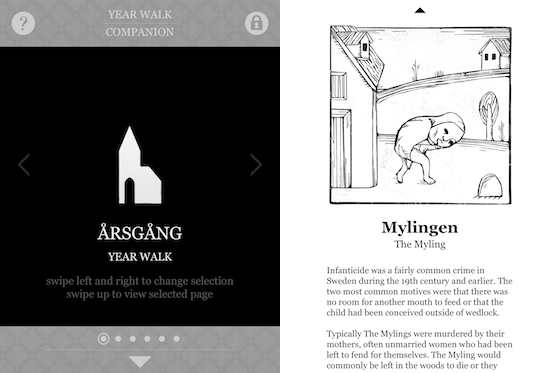
The Year Walk Companion is the definitive guide to the mysterious myths and creatures encountered in the game Year Walk. A mini-encyclopedia to keep handy when playing, or in preparation of your adventure. Or perhaps for contemplation after having finished your year walk?Year Walk Companion covers a range of forgotten beliefs and superstitions and goes deeper into the subject of year walking, as well as the supernatural beings found in the game.Created in collaboration with folk lore and ethnology expert Theodor Almsten, the free Year Walk Companion is essential to those who wish to get the most out of Year Walk.Who knows what secrets it may hide? IvyBeitner, Still 5 ⭐️ but needed to be way longerThis is the first interesting and deeply well thought out game I have come across in a few years. The concept really makes you think, just the right amount of creepy, based on Scandinavian folklore, gorgeous artwork and very very very unique gameplay. This is the exact type of game I've been searching for!
The ONLY thing I didn't like was how short it was, especially for a paid app. I beat the entire walk in just a few short hours, I really didn't want it to end! I hope I see additional year walks come out because I'd love to continue the journey! Still giving 5 stars because I was so impressed with the game.